

If you’ve searched for the best ecommerce platform for small businesses, you’ve probably already read three or four articles that all say the same thing: Shopify is best for growth, Wix is easiest for beginners, Squarespace looks the nicest, and BigCommerce is great once you’re bigger. All of that is true. It’s also incomplete.
What almost nobody mentions is what happens after you sign up. The monthly plan price on the pricing page is rarely what you end up paying once apps, themes, and processing fees stack up. Fewer still mention that selling into more than one state can trigger a sales tax obligation you never saw coming, or that your storefront could become the target of a lawsuit simply because a screen reader can’t read your checkout button. This guide covers the usual ground, then goes into the parts of the decision that tend to get skipped.
What actually matters when choosing an ecommerce platform
Every comparison starts with the same five factors, and for good reason: they’re the ones that decide whether you’re happy with your choice six months in.
Cost comes first, but not the sticker price. You want the number that includes transaction fees, the theme you’ll actually buy, and the apps you’ll need for things like abandoned cart emails or reviews. Ease of use matters just as much, especially if you’re running the store yourself with no developer on call.
Customization determines whether your site looks like every other store built on the same template. Scalability decides whether you’ll need to migrate in eighteen months. And payment flexibility, meaning how many gateways and currencies the platform supports, decides how many customers you can actually take money from.
A sixth factor rarely gets its own line item, and it should: how much of the platform’s promised feature set is included versus sold separately as an app. Two platforms can list identical features on their comparison pages and cost wildly different amounts once you add up what’s actually bundled.
It’s also worth asking who actually reviewed the platform you’re reading about. A lot of “best ecommerce platform for small businesses” roundups are written by affiliates who earn a commission when you sign up through their link, which doesn’t make the advice wrong, but it does mean the article has a reason to steer you toward whichever platform pays the highest referral fee. Look for pieces that disclose a testing methodology, show real pricing tables, or name an actual reviewer, rather than ones that read like the same five paragraphs rearranged under a new logo.
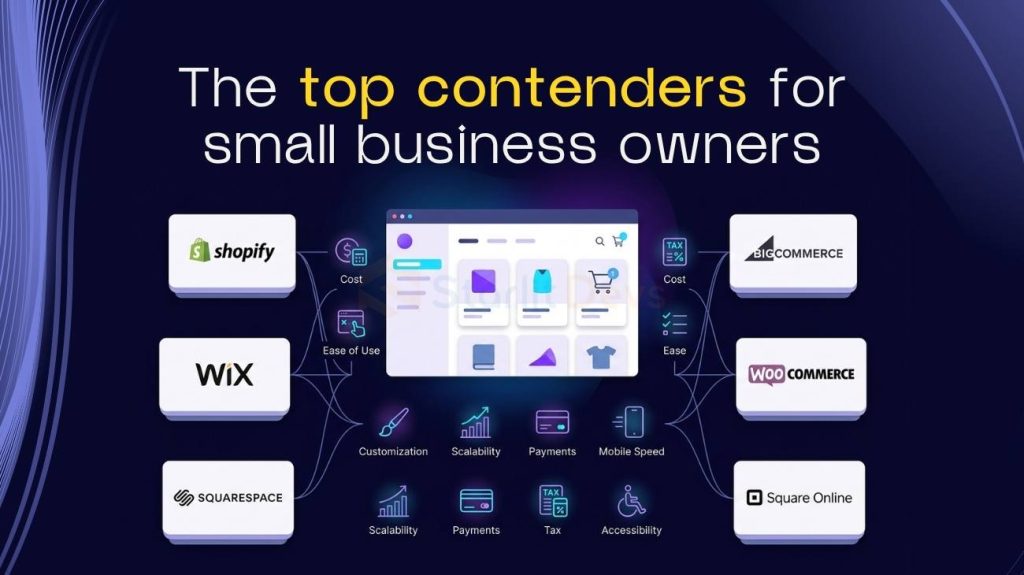
The top contenders for small business owners
- Shopify remains the default answer for a reason. Plans start around $39 a month, the app ecosystem is the largest in the industry at more than 8,000 apps, and setup takes a weekend rather than a month. The tradeoff is that Shopify’s dashboard gets busy fast, and you’ll pay 0.5% to 2% extra on every sale if you skip Shopify Payments for a third-party processor.
- Wix wins on speed and design freedom for very small catalogs. Its drag-and-drop editor is genuinely the easiest to learn, and pricing starts near $29 a month once you add ecommerce. The catch: you can’t switch templates after you publish, and past roughly 50 products, the editor starts to feel like it’s fighting you.
- Squarespace is the pick for brands where the photos do the selling: fashion, wellness, home goods. Templates are the best-looking of any platform here, and pricing runs $23 to $36 a month depending on the plan. Site speed suffers under heavy image galleries, and its app library is thin compared to Shopify or BigCommerce.
- BigCommerce is built for stores that outgrow simpler tools: large catalogs, multiple storefronts, B2B pricing. It charges no extra transaction fee on any plan, which matters once you’re doing real volume, though the templates look dated next to Wix or Squarespace and the learning curve is steep for a first-time owner.
- WooCommerce is the right call only if you’re already comfortable with WordPress, or plan to be. The plugin itself is free, but hosting, a decent theme, and a handful of extensions usually land you between $50 and $150 a month once it’s actually running, and you’re responsible for every update and security patch yourself.
- Square Online makes sense for a business that already takes payments in person. Its free plan is the only one on this list with genuinely no monthly fee, and syncing online orders with an in-store POS is where it beats everyone else. It’s not built for a business that wants to grow into a serious standalone online store.
Platform | Price | Best for |
Shopify | Starts around $39/mo (Basic plan) | Businesses that want the deepest app ecosystem and the most room to scale |
Wix | Ecommerce starts near $29/mo | Small catalogs (under 50 products) that want fast setup and full design control |
Squarespace | $23–$36/mo depending on plan | Visual, design-forward brands like fashion, wellness, and home goods |
BigCommerce | From $29/mo, no added transaction fees on any plan | Merchants with real sales volume, B2B pricing needs, or multiple storefronts |
WooCommerce | Plugin is free; realistically $50–$150/mo once hosting and extensions are added | Businesses already on WordPress that want full control and don’t mind the maintenance |
Square Online | Free plan available | Businesses that already take payments in person and want POS sync |

Mobile speed matters more than the demo store suggests
Most comparison articles show you a demo store on a laptop screen, which is exactly how almost none of your customers will actually shop. The majority of retail site visits now happen on a phone, and shoppers are far less patient there than reviewers testing a platform on fiber internet.
A site that takes more than a few seconds to load loses a meaningful share of visitors before they ever see a product page, and that’s true no matter how good the platform’s dashboard looks in a screenshot.
This is where platform choice quietly matters more than most buying guides let on. Shopify and Wix both optimize themes for mobile by default, and Squarespace’s image-heavy templates tend to load slower unless you compress every photo yourself before uploading.
WooCommerce’s speed depends almost entirely on your hosting provider, which means two WooCommerce stores can perform completely differently even though they’re running the same software. Before you commit to any of the best ecommerce platform for small businesses options on your shortlist, load the demo store on your own phone over a normal mobile connection, not the office Wi-Fi, and see how it actually feels.

The real cost nobody puts in the headline
Run the math at a modest $5,000 a month in sales and the picture changes. A Shopify Basic store at $39 a month, plus a realistic $100 to $200 a month in apps for email, reviews, and upsells, plus card processing, plus the 0.5% to 2% surcharge for skipping Shopify Payments, lands closer to $250 to $400 a month than the $39 on the pricing page. BigCommerce avoids that surcharge entirely, which can offset its slightly higher entry price once your volume grows. WooCommerce’s “free” plugin turns into $50 to $150 a month the moment you count hosting, a paid theme, and the plugins most stores end up needing.
None of this means any of these platforms is a bad deal. It means the plan you compare on a pricing page is almost never the plan you’re actually paying for by month three, and building a rough version of that math before you commit will save you from an unpleasant surprise on your first quarterly statement.
The tax problem almost nobody warns you about
Here’s something none of the popular buying guides mention: the moment your online store starts selling into other states, you may owe sales tax there, even if you’ve never set foot in the state and never hired anyone there.
This is called economic nexus, and it’s been the law nationwide since a 2018 Supreme Court ruling replaced the old rule that required a physical presence before a state could make you collect its tax. Under the new rule, a state can require you to register and collect sales tax based purely on how much business you do there.
Most states set that line at $100,000 in annual sales. A handful set it higher: California, Texas, and New York require $500,000, while Alabama and Mississippi use $250,000. Several states used to also count transaction volume, which unfairly caught small sellers of cheap items, and states have been quietly dropping that rule; Illinois removed its transaction-count trigger at the start of 2026, joining more than a dozen others.
The trap is that this creeps up on sellers gradually. You cross $100,000 in sales to a state you barely thought about, keep selling for another year without registering, and by the time a state notice arrives, the back taxes, interest, and penalties can exceed the profit you made on the sales that triggered it in the first place.
None of the ecommerce platforms handle this automatically end to end. Shopify, BigCommerce, and WooCommerce can calculate tax at checkout if you configure it correctly, but registering in a state, filing returns, and tracking which states you’re approaching the threshold in is still on you. If you’re selling into more than a handful of states, this is worth building into your platform decision, not treating as an afterthought once you’re already generating revenue there.

Accessibility lawsuits are the fastest-growing risk in ecommerce
This one barely gets a mention anywhere, and it should get more attention than almost anything else on this list. Website accessibility lawsuits under the Americans with Disabilities Act hit roughly 3,900 federal filings in 2025, up close to 24% from the year before, and online retailers accounted for somewhere between 69% and 77% of all of them, according to tracking by Seyfarth Shaw and UsableNet.
Most of the businesses named weren’t household names. A large share had annual revenue under $25 million, and settlements typically run $25,000 to $30,000 once a case is filed.
None of the six platforms above ship with full accessibility compliance out of the box. A theme that looks great can still fail basic screen-reader navigation, missing alt text, or keyboard-only checkout, which are the three issues that show up in the majority of these lawsuits.
Wix and Shopify both offer accessibility-focused apps and themes, and it’s worth checking a theme against the WCAG 2.1 AA standard, the benchmark courts have been using, before you launch rather than after a demand letter shows up.

What happens if you pick wrong
Switching platforms later is more expensive than most people expect going in. Moving a live store, including product data, customer records, and the SEO value you’ve built into your existing product pages, typically takes a couple of months and can run several thousand dollars if you hire help rather than do it yourself. That’s not a reason to freeze up over the decision. It is a reason to think about where your business will be in two years, not just where it is today, before you commit.
Matching the platform to your business
There’s no single best ecommerce platform for small businesses across every product type and budget, which is exactly why the six-way comparisons above matter more than a single “winner.”
If you’re selling fewer than fifty products and want the fastest possible launch, Wix or Square Online will get you there in a weekend.
If you expect real growth, want the biggest selection of apps, and don’t mind a busier dashboard, Shopify is still the safest general-purpose pick.
If your products are visual and your brand depends on how the site looks, Squarespace earns its higher price.
If you’re already running on WordPress or want full control and don’t mind the maintenance, WooCommerce is the honest choice.
And if you’re doing meaningful volume, selling wholesale alongside retail, or want to avoid transaction fees permanently, BigCommerce is worth the steeper learning curve.

Frequently asked questions
What is the best ecommerce platform for small businesses?
There isn’t one universal answer. For most first-time sellers who want to launch fast without a developer, Shopify offers the best balance of ease of use and room to grow. But the right choice depends heavily on your product type, your budget, and how many states you plan to sell into.
Which is the best ecommerce platform for small businesses on a tight budget?
Square Online’s free plan and Wix’s entry-level tier are the cheapest ways to start selling with no monthly commitment. WooCommerce can be cheaper long-term if you’re comfortable managing your own hosting.
How much does an ecommerce platform actually cost per month?
Budget for more than the sticker price. A realistic small store spends $50 to $400 a month once you add apps, a theme, and payment processing, depending on the platform and how much you’re selling.
Do I need to worry about sales tax if I only sell in my own state?
Not from an economic nexus standpoint, but the moment you start shipping meaningful volume to other states, check each state’s threshold. Most sit at $100,000 in annual sales.
Is my ecommerce store at risk of an ADA lawsuit even as a small business?
Yes. Nearly 70% of website accessibility lawsuits filed in the past two years targeted online retailers, and most of the businesses sued had no idea they were exposed until a letter arrived.
The bottom line
Choosing the best ecommerce platform for small businesses is a smaller decision than what you do after you launch it. The platform gets your store online. Whether you stay compliant with tax law in every state you sell into, whether your checkout page can withstand an accessibility lawsuit, and whether your true monthly cost matches what you budgeted are the things that decide whether year two looks better than year one. Pick the platform that fits your product and your comfort with technology, then build the rest of the business around it with your eyes open.

Founding Starlit Devs has allowed us to extend our expertise globally, serving over 500 clients, including Fortune 1000 companies, with custom web development services. Our commitment to delivering exceptional design and development is coupled with a deep understanding of SEO, which has been pivotal in empowering businesses to achieve maximum online engagement and brand growth. At Starlit Devs, we take pride in our mission to provide websites that stand out in a competitive digital landscape and drive tangible results for our clients.
