

Most ecommerce brands invest heavily in ads, homepage redesigns, and product photography. Yet one of the highest-intent areas of the buying journey often receives minimal strategic attention: internal search.
When shoppers use your search bar, they are not casually browsing. They are actively looking for something specific. That moment represents peak buying intent. If your site delivers fast, relevant, and intelligently ranked results, conversions increase. If it fails, revenue disappears quietly.
This guide breaks down ecommerce site search best practices that US ecommerce brands can implement to improve relevance, increase conversions, and turn internal search into a measurable growth engine.
If you treat search as infrastructure rather than a simple feature, it becomes one of the most powerful levers in your entire ecommerce strategy.

Ecommerce Site Search Best Practices That Drive Revenue
Ecommerce site search best practices are not just UX improvements. They are revenue multipliers hiding in plain sight.
Most ecommerce brands obsess over homepage design, paid ads, and product page optimization. Meanwhile, high-intent shoppers are typing exactly what they want into the search bar and expecting instant, accurate results. When that experience fails, revenue leaks quietly.
Here is the reality: shoppers who use internal search convert significantly higher than those who browse. Various industry studies consistently show that search users are 2 to 4 times more likely to purchase compared to non-search users. Why? Because they already know what they want. Your job is to remove friction.
Let’s break down why site search deserves strategic attention.
1. Search Users Have High Buying Intent
When someone types “men’s waterproof hiking boots size 11,” they are not casually browsing. They are deep in the decision stage.
A weak search experience at this moment creates frustration. A strong one accelerates checkout.
For US ecommerce brands competing in crowded markets, that difference can mean thousands in lost revenue every month.
2. Search Shortens the Path to Purchase
Navigation menus work. Category pages work. But search collapses the journey from discovery to product in seconds.
Instead of:
Home → Category → Subcategory → Filter → Scroll
Search users go:
Search → Product → Add to cart
That speed directly impacts conversion rate and average order value.
3. Search Reduces Friction in Large Catalogs
The bigger your SKU count, the more critical search becomes.
Brands with:
- 500+ products
- Multiple variants
- Seasonal inventory
- Complex product attributes
cannot rely on navigation alone. Without optimized search, customers struggle to locate specific items, especially on mobile.
4. Search Data Reveals Customer Demand
Your internal search box is a goldmine of customer intent data.
It tells you:
- What shoppers are actively looking for
- What products you do not carry but should
- Where zero-result gaps exist
- Which terms drive the most revenue
Smart ecommerce brands treat search analytics as product research and merchandising insight.
5. Search Impacts Revenue More Than You Think
Here is the overlooked truth: improving search performance often produces faster ROI than redesigning your homepage.
Why?
Because you are optimizing for users who are already closest to purchasing.
If your brand is serious about scaling in the US market, ecommerce site search best practices should not be a “nice to have.” They should be part of your core conversion strategy.

Why Most Ecommerce Site Search Experiences Fail
Ecommerce site search best practices are well known, yet many stores still underperform because search is treated as a basic feature, not a revenue lever.
For US ecommerce brands, even small search issues can cost serious sales. Here is where things typically break.
1. Zero-Result Pages That Stop Buyers
A shopper searches “black running sneakers size 9.”
Your site responds: No results found.
Common causes:
- No synonym setup
- Overly strict filters
- Poor product tagging
- Mismatch between product names and customer language
If the page offers no alternatives or suggestions, momentum disappears instantly.
2. No Tolerance for Typos or Natural Language
Customers type casually:
- “nik air max”
- “cofee maker”
- “sofa under 500”
If search requires perfect spelling or exact matches, results feel broken. Modern shoppers expect search to interpret intent, not punish mistakes.
3. Poor Product Ranking Logic
Default sorting by newest or alphabetical rarely aligns with buyer expectations.
Customers want:
- Best sellers
- In-stock items
- High-rated products
- Relevant price options
Search ranking is merchandising. If irrelevant or out-of-stock items appear first, trust drops.
4. Slow Response Time
Search must feel instant. Even small delays increase frustration, especially on mobile. In a market shaped by Amazon-level speed, lag equals lost conversions.
5. Weak Mobile Experience
With most US ecommerce traffic coming from mobile, search must be frictionless.
Common issues:
- Hard-to-find search bars
- Tiny icons
- Clunky filters
- Excessive scrolling
If mobile search feels difficult, users leave.
6. No Personalization
Serving identical results to every user ignores valuable signals like browsing history, location, and repeat behavior.
Without personalization, brands miss opportunities to increase relevance and average order value.
7. No Measurement or Optimization
Many brands fail to track:
- Top search terms
- Zero-result queries
- Search exit rates
- Revenue per search
Without data, there is no improvement cycle. And without optimization, ecommerce site search best practices remain theory instead of growth strategy.

Advanced Ecommerce Site Search Best Practices for High-Growth Brands
Advanced ecommerce site search best practices separate fast-growing brands from stagnant ones. Once the fundamentals are in place, the next layer is intelligence, automation, and strategic integration.
If your brand is scaling across the US market, expanding SKUs, or competing with major marketplaces, these upgrades become essential.
1. AI-Powered Search and Machine Learning Ranking
Traditional search follows rules.
AI-powered search learns.
Modern search engines use machine learning to:
- Analyze click behavior
- Track add-to-cart actions
- Monitor purchase patterns
- Adjust ranking dynamically
If customers consistently click the third product for a specific query, the system can automatically promote it.
Over time, search results improve without manual intervention.
That is where real performance gains happen.
2. Semantic Search and Intent Recognition
Keyword matching is limited. Semantic search understands meaning.
For example:
- “Affordable formal shoes”
- “Budget office chair”
- “Best protein for muscle gain”
Instead of matching exact terms, semantic search interprets intent and contextual relevance.
This is particularly important for US shoppers who use conversational queries influenced by Google and voice assistants.
Brands that adopt semantic search see better relevance and fewer zero-result searches.
3. Visual Search Capabilities
Visual search is growing, especially in fashion, home decor, and lifestyle ecommerce.
Customers can:
- Upload an image
- Take a photo
- Click a visual reference
The system then matches similar products in your catalog.
For brands with strong product imagery, this can significantly increase engagement and discovery.
It reduces dependency on keywords altogether.
4. Voice Search Optimization
Voice queries tend to be longer and more conversational.
Instead of:
“Leather jacket”
Customers say:
“Show me black leather jackets under 300 dollars.”
Advanced ecommerce site search best practices include optimizing for longer, natural-language queries and structured data that supports voice-driven search experiences.
This is particularly relevant as smart devices and voice shopping adoption grow in the US.
5. Integration with Merchandising Strategy
Search should not operate independently from marketing and merchandising.
High-growth brands integrate search with:
- Promotions
- Seasonal campaigns
- Inventory priorities
- Paid advertising strategy
For example:
During Black Friday, certain SKUs can be boosted in search results automatically.
During clearance events, overstock items can be prioritized.
Search becomes a controlled revenue lever.
6. Headless Commerce Compatibility
As brands adopt headless commerce architecture, search must remain flexible and API-driven.
Modern ecommerce ecosystems require:
- Fast indexing
- Real-time inventory sync
- Scalable infrastructure
- Omnichannel integration
If your search system cannot scale with your tech stack, it becomes a bottleneck.
Advanced ecommerce site search best practices align with long-term technical scalability, not just short-term UX improvements.
7. A/B Testing Search Performance
High-performing brands do not guess. They test.
You can A/B test:
- Ranking rules
- Autocomplete design
- Search layout
- Filter placement
- Personalization logic
Measure:
- Conversion rate
- Revenue per visitor
- Average order value
- Click-through rate
Search optimization is an ongoing revenue experiment, not a one-time setup.
At this stage, ecommerce site search shifts from being a support feature to becoming a growth engine.
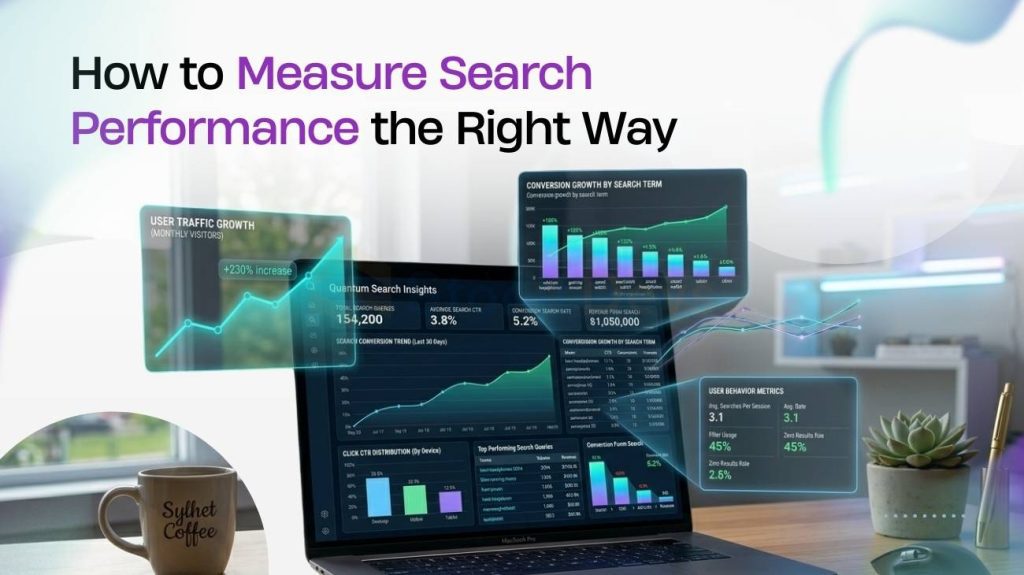
How to Measure Search Performance the Right Way
Ecommerce site search best practices only deliver results when tracked properly. Without data, you cannot optimize.
For growth-focused US ecommerce brands, internal search deserves its own dashboard. Focus on these key metrics.
1. Search Usage Rate
Percentage of sessions that use search.
Low usage may signal:
- Poor visibility
- Weak mobile UX
- Low usability
Even small increases can lift total revenue since search users often convert at higher rates.
2. Conversion Rate: Search vs Non-Search
Compare conversion rates between users who search and those who do not.
Search users should convert significantly higher. If the gap is small, your search experience likely needs improvement.
3. Revenue Per Search User
Go beyond conversion rate.
Track:
- Average order value from search users
- Revenue per search session
- Total revenue influenced by search
If search drives high-value orders, it deserves more investment.
4. Zero-Result Rate
Percentage of searches that return no results.
High rates usually indicate:
- Missing synonyms
- Poor indexing
- Inventory gaps
This metric directly exposes lost revenue.
5. Search Exit Rate
How often users leave after searching.
If customers search and exit without clicking, relevance is likely weak.
6. Top Search Queries
Your most searched terms reveal real demand.
Use them to guide:
- Inventory decisions
- SEO strategy
- Paid campaigns
- Landing page optimization
Search data is a built-in demand forecasting tool.
7. Revenue Per Search Term
Some queries generate far more revenue than others.
Boosting high-value search terms or building targeted campaigns around them aligns ecommerce site search best practices with merchandising strategy.
Tools to Track Search
Most brands can track internal search using:
- Google Analytics
- Shopify analytics
- WooCommerce plugins
- Enterprise search dashboards
If detailed tracking is missing, that is a structural gap worth fixing.
When measured correctly, search performance becomes a clear indicator of buyer intent and revenue efficiency.
Conclusion
Ecommerce site search best practices are not minor UX upgrades. They are direct revenue drivers.
Search users show the strongest buying intent on your site. If your search experience is fast, intelligent, and strategically ranked, conversions rise. If it is slow, irrelevant, or poorly optimized, you lose ready-to-buy customers.
For US ecommerce brands competing in saturated markets, optimized search is no longer optional. It is a competitive advantage.
Brands that treat internal search as infrastructure, not a feature, consistently see stronger engagement, higher average order value, and better overall revenue efficiency.

Ready to Turn Search Into a Revenue Engine?
If your ecommerce search is underperforming, the fix is rarely just installing another plugin. It requires:
- Strategic ranking logic
- Synonym and intent mapping
- UX refinement
- Advanced analytics
- Ongoing optimization
If you want to improve conversions and unlock measurable growth, let’s audit your current search experience and identify the highest-impact opportunities.
The fastest way to increase revenue may already be sitting in your search bar.

FAQs About Ecommerce Site Search Best Practices
1. What is ecommerce site search?
It is the internal search tool that helps users find products within your store. Optimized search interprets intent, handles typos, and ranks products for conversions.
2. Why is site search important?
Search serves high-intent shoppers. If results are fast and relevant, conversions increase. If not, users leave.
3. Does site search increase conversions?
Yes. Search users typically convert much higher than browsers because they are closer to purchase.
4. What is a zero-result search?
It happens when a query returns no products, often due to typos, missing synonyms, or poor tagging. High rates mean lost revenue.
5. How can I improve search results?
Add autocomplete, enable typo tolerance, map synonyms, optimize ranking logic, add filters, and track analytics. Advanced setups include AI and personalization.
6. What is AI-powered search?
It uses machine learning to adjust rankings based on clicks and purchases, improving relevance automatically.
7. How do I track search performance?
Use Google Analytics, Shopify, WooCommerce plugins, or enterprise dashboards. Monitor usage rate, zero-result rate, exit rate, and revenue from search.
8. What is the ideal search response time?
Under one second. Results and autocomplete should feel instant to avoid drop-offs.

Founding Starlit Devs has allowed us to extend our expertise globally, serving over 500 clients, including Fortune 1000 companies, with custom web development services. Our commitment to delivering exceptional design and development is coupled with a deep understanding of SEO, which has been pivotal in empowering businesses to achieve maximum online engagement and brand growth. At Starlit Devs, we take pride in our mission to provide websites that stand out in a competitive digital landscape and drive tangible results for our clients.
- Mahfuz M
