
Most WooCommerce stores invest in themes, ads, and product pages. Yet many still struggle with slow operations, poor conversions, and disconnected systems.
The real issue is not traffic or design. It is how your tools work together.
In this guide, you will discover the most effective ecommerce integrations for WooCommerce, how they impact performance, and how to choose the right setup for your store.
What Are Ecommerce Integrations and Why They Matter for Growth
Ecommerce integrations are the connections between your online store and the tools you use to run your business. These tools can include payment gateways, CRM systems, email marketing platforms, shipping software, and analytics tools. Instead of working in isolation, ecommerce integrations allow these systems to share data and automate workflows.
In simple terms, ecommerce integrations turn your store from a standalone website into a connected ecosystem.
For WooCommerce store owners, this is critical. WooCommerce is flexible by design, but its real power comes from how well it integrates with other tools. Without the right integrations, you are left managing orders, customer data, and marketing manually. That slows growth and increases errors.
A recent industry report shows that businesses using integrated systems can improve operational efficiency by up to 30 percent. That translates directly into faster order processing, better customer experiences, and higher conversion rates.
How Ecommerce Integrations Work in Practice
Ecommerce integrations work by syncing data between your WooCommerce store and external platforms. For example:
- When a customer places an order, the data is automatically sent to your CRM
- Your email tool triggers a confirmation or upsell sequence
- Your inventory system updates stock levels in real time
- Your shipping software generates labels and tracking details
All of this happens without manual input.
This level of automation is what allows modern ecommerce brands to scale without increasing operational complexity.
Types of Ecommerce Integrations
Not all ecommerce integrations are built the same. Understanding the types helps you choose the right setup for your store.
Native Integrations
These are built directly into WooCommerce or supported through official plugins.
They are easy to set up and ideal for most store owners.
Third-Party Integrations
These come from external tools and platforms.
Examples include email marketing tools or CRMs that connect via plugins or connectors.
These are tailored solutions built specifically for your business.
They allow deeper control, better performance, and more complex workflows.
Why Ecommerce Integrations Directly Impact Growth
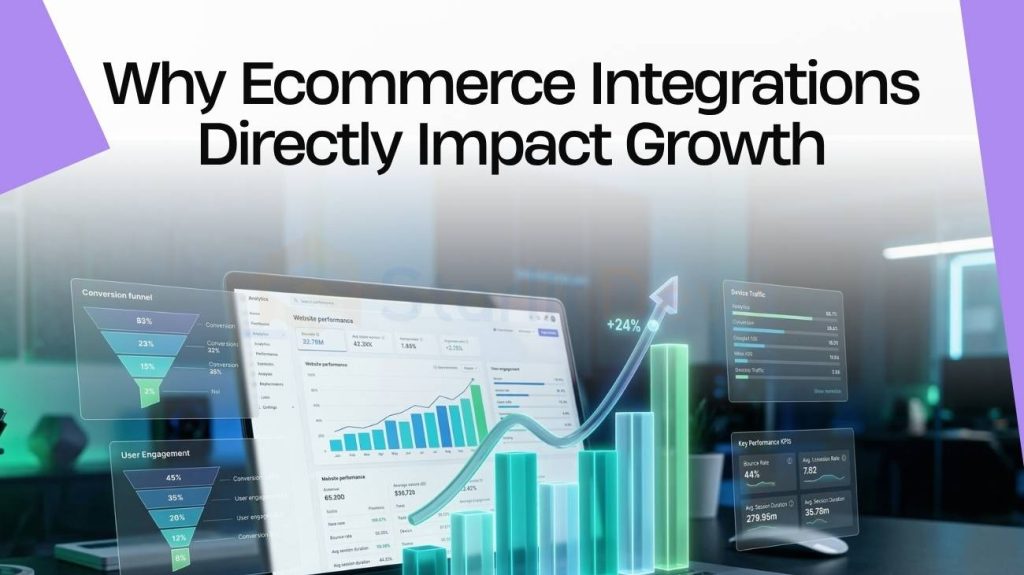
Ecommerce integrations are not just a technical setup. They directly influence your revenue and scalability.
Here’s how:
- Faster operations
Orders, inventory, and customer data move automatically - Better customer experience
Personalized emails, accurate stock, and smooth checkout - Improved marketing performance
Data-driven campaigns based on real customer behavior - Reduced manual errors
Less reliance on spreadsheets and manual updates
Without ecommerce integrations, growth becomes harder to sustain. You spend more time managing systems instead of optimizing your store.
With the right integrations in place, your WooCommerce store becomes efficient, scalable, and ready for higher conversion rates.
How Ecommerce Integrations Improve Store Performance and Conversions
Ecommerce integrations play a direct role in improving how your store performs and how well it converts visitors into customers. When your tools are connected, your store becomes faster, smarter, and more responsive to customer behavior.
For WooCommerce store owners, ecommerce integrations are often the difference between a store that operates manually and one that scales efficiently.
Studies show that improving customer experience alone can increase conversion rates by up to 20 percent. Most of that improvement comes from better systems working together behind the scenes.
Faster Checkout and Reduced Cart Abandonment
One of the biggest conversion killers in ecommerce is a slow or complicated checkout process.
Ecommerce integrations solve this by connecting your store with reliable payment gateways and checkout tools. Customers can pay quickly using trusted methods without friction.
- Faster page loads
- Multiple payment options
- Secure transactions
All of this reduces hesitation and increases completed purchases.
Better Customer Data and Personalization
Ecommerce integrations allow your WooCommerce store to collect and sync customer data across platforms.
This means you can:
- Track browsing behavior
- Understand purchase history
- Segment users based on actions
With this data, your marketing becomes more targeted.
For example:
- Send personalized product recommendations
- Trigger abandoned cart emails
- Offer discounts based on user behavior
Personalization like this can significantly boost engagement and repeat purchases.
Automated Operations That Save Time
Without ecommerce integrations, many store operations are manual.
That includes:
- Order processing
- Inventory updates
- Customer communication
Integrations automate these workflows.
- Orders are processed instantly
- Stock levels update in real time
- Emails are triggered automatically
This not only saves time but also reduces errors that can hurt customer trust.
Improved Marketing ROI
Ecommerce integrations connect your store with marketing tools that track and optimize performance.
You can:
● Measure campaign results accurately
● Retarget users based on behavior
● Optimize ad spend using real data
Instead of guessing what works, you rely on data.
This leads to:
● Higher ROI on ads
● Better email performance
● More efficient customer acquisition
Stronger Insights for Continuous Optimization
When your analytics tools are integrated, you gain full visibility into your store’s performance.
You can see:
- Where users drop off
- Which products convert best
- Which channels drive revenue
This allows you to continuously improve your store.
Without ecommerce integrations, you are making decisions in the dark. With them, every decision is backed by data.
In short, ecommerce integrations transform your WooCommerce store into a high-performing system. They remove friction, improve customer experience, and create a foundation for consistent growth.
Best Ecommerce Integrations for WooCommerce Stores (2026 List)
Ecommerce integrations are only valuable if they directly impact revenue, efficiency, or customer experience. Many WooCommerce stores install too many tools without a clear strategy, which leads to slower performance and poor results.
This list focuses on high-impact ecommerce integrations that actually move the needle for WooCommerce stores in 2026.
Payment Integrations
Payment integrations are critical for conversion. If customers do not trust your checkout, they will not complete the purchase.
Top options:
- Stripe – Supports cards, wallets, and global payments
- PayPal – Trusted brand with one-click checkout
- net – Reliable for US-based businesses
Why they matter:
- Faster checkout experience
- Multiple payment options
- Higher trust and lower abandonment
Marketing and Automation Integrations
Marketing integrations help you turn traffic into revenue through automation and personalization.
Top options:
- Klaviyo – Advanced email and SMS automation
- Mailchimp – Beginner-friendly email marketing
- HubSpot – All-in-one marketing and CRM platform
Why they matter:
- Automated email flows
- Customer segmentatio
- Increased repeat purchases
CRM Integrations
CRM integrations give you a complete view of your customers and their journey.
Top options:
- HubSpot CRM – Easy to use and integrates well with WooCommerce
- Salesforce – Enterprise-level customer management
Why they matter:
- Track customer interactions
- Improve retention strategies
- Align marketing and sales
Inventory and Order Management Integrations
Managing inventory manually leads to overselling and stock issues.
Top options:
- QuickBooks Commerce (formerly TradeGecko)
- Zoho Inventory
Why they matter:
- Real-time stock updates
- Multi-channel inventory sync
- Fewer operational errors
Shipping and Fulfillment Integrations
Shipping directly affects customer satisfaction and repeat purchases.
Top options:
- ShipStation – Powerful shipping automation
- Shippo – Easy label generation and tracking
Why they matter:
- Faster order fulfillment
- Lower shipping costs
- Better tracking experience
Analytics and Tracking Integrations
Without data, you cannot optimize your store.
Top options:
- Google Analytics 4 – Essential for tracking user behavior
- Hotjar – Visual insights through heatmaps and recordings
Why they matter:
- Identify conversion bottlenecks
- Understand user behavior
- Improve UX and CRO decisions
How to Prioritize These Ecommerce Integrations
Not every store needs every tool at once.
Start with:
- Payment integrations
- Analytics tools
- Marketing automation
Then scale into:
- CRM systems
- Inventory management
- Advanced fulfillment tools
The key is not to install more ecommerce integrations. The goal is to implement the right ones that align with your growth stage.
When chosen correctly, these integrations create a streamlined WooCommerce system that supports higher conversions and long-term scalability.
How to Choose the Right Ecommerce Integrations for Your Store
Ecommerce integrations can either streamline your operations or slow your store down. Choosing the right ones is not about adding more tools. It is about selecting integrations that solve real problems and support your growth goals.
For WooCommerce stores, this decision directly affects performance, scalability, and conversion rates.
Identify Your Bottlenecks First
Before adding any ecommerce integrations, you need to understand where your store is struggling.
Ask:
- Are users abandoning checkout?
- Is order processing too slow?
- Are you lacking customer insights?
- Is inventory management messy?
Each problem points to a specific type of integration.
For example:
- High cart abandonment → better payment or checkout integrations
- Low retention → email marketing automation
- Operational delays → inventory or fulfillment tools
Check WooCommerce Compatibility
Not all ecommerce integrations work seamlessly with WooCommerce.
Look for:
- Official WooCommerce plugins
- Well-documented integrations
- Regular updates and support
Poor compatibility can lead to:
- Site errors
- Data syncing issues
- Broken customer experiences
Always prioritize tools that are proven to work within the WooCommerce ecosystem.
Evaluate Ease of Integration
Some tools are plug-and-play. Others require custom development.
- Simple plugins are quick to install but may have limitations
- Custom API integrations offer flexibility but need technical expertise
Choose based on your current stage:
- Small to mid-size stores → start with reliable plugins
- Scaling stores → consider custom integrations for better performance
Consider Scalability and Cost
Many ecommerce integrations look affordable at the start but become expensive as you grow.
Evaluate:
- Pricing based on usage or contacts
- Hidden costs (add-ons, upgrades)
- Long-term scalability
A tool that works today should still support your business when traffic and orders increase.
Focus on Data Sync and Accuracy
One of the biggest risks with ecommerce integrations is inconsistent data.
If your systems are not syncing properly:
- Inventory can become inaccurate
- Customer data can be fragmented
- Marketing campaigns can fail
Choose integrations that provide:
- Real-time or near real-time syncing
- Reliable data flow between systems
Prioritize Performance Impact
Too many poorly optimized ecommerce integrations can slow down your WooCommerce store.
This affects:
- Page load speed
- User experience
- SEO rankings
Always:
- Test performance after installing integrations
- Remove unused or redundant tools
- Optimize scripts and requests
Choosing the right ecommerce integrations is a strategic decision, not a technical one. When done correctly, it creates a system that supports growth without adding complexity.
The goal is simple. Every integration should either increase revenue, save time, or improve customer experience. If it does not, it does not belong in your stack.
Why Custom Ecommerce Integrations Drive Better ROI
Ecommerce integrations are powerful, but not all integrations are built to maximize ROI. Most WooCommerce stores rely on off-the-shelf plugins. While these work for basic needs, they often fall short as your business grows.
This is where custom ecommerce integrations become a competitive advantage.
Limitations of Plug-and-Play Integrations
Pre-built integrations are designed for mass use. That means they are not tailored to your specific workflows.
Common limitations include:
- Unnecessary features that slow down your store
- Limited flexibility in automation
- Incomplete data syncing between systems
- Compatibility issues with other plugins
As your store scales, these limitations start affecting performance and efficiency.
When You Need Custom Ecommerce Integrations
Not every store needs custom solutions from day one. But there are clear signs when it becomes necessary.
You should consider custom ecommerce integrations if:
- You are using multiple tools that do not sync properly
- Your workflows require manual intervention
- You are scaling operations across multiple channels
- Your site performance is affected by too many plugins
At this stage, plug-and-play solutions become a bottleneck.
Benefits of Custom Ecommerce Integrations
Custom integrations are built around your business, not the other way around.
Faster Performance
Custom solutions remove unnecessary scripts and reduce load on your WooCommerce site. This improves speed and user experience.
Tailored Workflows
You can automate processes exactly the way your business operates. No limitations from generic plugin settings.
Accurate Data Synchronization
Data flows seamlessly between systems. This eliminates inconsistencies and improves decision-making.
Scalability
Custom ecommerce integrations are designed to grow with your store. You are not restricted by plugin limitations or pricing tiers.
Better Alignment With CRO Goals
If your goal is to increase conversions, generic integrations may not be enough.
Custom ecommerce integrations allow you to:
- Build advanced personalization workflows
- Track user behavior more accurately
- Optimize checkout and post-purchase flows
This creates a direct impact on revenue and customer lifetime value.
Why Implementation Matters More Than Tools
Many store owners focus on choosing the “best” tools. But tools alone do not guarantee results.
The real difference comes from:
- How integrations are implemented
- How data flows between systems
- How workflows are optimized
This is where expert support becomes valuable.
Custom ecommerce integrations are not just a technical upgrade. They are a strategic investment in performance, scalability, and revenue growth.
For WooCommerce stores aiming to scale, they provide the flexibility and efficiency that pre-built solutions often cannot deliver.

Founding Starlit Devs has allowed us to extend our expertise globally, serving over 500 clients, including Fortune 1000 companies, with custom web development services. Our commitment to delivering exceptional design and development is coupled with a deep understanding of SEO, which has been pivotal in empowering businesses to achieve maximum online engagement and brand growth. At Starlit Devs, we take pride in our mission to provide websites that stand out in a competitive digital landscape and drive tangible results for our clients.
