
In 2026, most businesses asking how much does a website redesign cost find the answer ranges from $3,000 to $150,000+, depending on scope, complexity, and provider.
The gap exists because a redesign is more than a visual update. It can involve UX research, conversion optimization, SEO migration, content updates, integrations, and performance improvements.
This guide breaks down real pricing ranges, key cost drivers, hidden expenses, and how to budget strategically so you can invest with clarity and confidence.

What Most Businesses Actually Spend
Small businesses typically land between $8,000 and $25,000.
Ecommerce brands often invest $20,000 to $60,000, especially if checkout optimization and integrations are involved.
Mid-market and enterprise companies frequently exceed $100,000, particularly when:
- Multiple user roles exist
- Complex CMS structures are required
- CRM or ERP integrations are needed
- Brand repositioning is part of the redesign
Why Cost Should Be Viewed as an Investment
According to industry benchmarks, improving UX can increase conversion rates by up to 200 percent, while strong UX design can raise conversions even higher.
If your website generates $50,000 per month, even a modest 20 percent improvement in conversions can justify a serious redesign investment.
The real question is not just how much does a website redesign cost.
It is how much revenue your current website is leaving on the table.
What Factors Influence Website Redesign Cost?
When businesses ask how much does a website redesign cost, the real answer depends on scope. Pricing increases based on complexity, functionality, and strategic depth.
Here are the main cost drivers.
1. Website Size and Page Count
A 10-page brochure website costs far less than a 150-page resource hub.
More pages mean:
- More design layouts
- More development time
- More content migration
- More QA testing
If your site has dozens of service pages, blog posts, or landing pages, expect costs to scale accordingly.
2. Custom Design vs Template Redesign
Template-based redesigns are faster and cheaper.
Fully custom UI design requires:
- Brand workshops
- Wireframing
- High-fidelity mockups
- Multiple revision rounds
Custom design improves differentiation and conversion potential. It also increases budget.
3. CMS Platform and Technology Stack
Your platform significantly affects pricing.
Redesigning a WordPress site differs from rebuilding on Shopify or developing a custom headless solution.
Costs rise when:
- Platform migration is required
- Custom functionality must be rebuilt
- Legacy systems are involved
Switching platforms almost always increases redesign cost.
4. Ecommerce Functionality
Ecommerce adds layers of complexity.
- Product filtering systems
- Checkout optimization
- Payment gateway integrations
- Inventory syncing
- Tax and shipping rules
An ecommerce redesign often costs 30–50 percent more than a standard business site.
5. SEO Migration and Preservation
One of the most overlooked cost factors.
If not handled correctly, redesigns can destroy rankings.
SEO migration includes:
- URL mapping
- Redirect strategy
- Metadata preservation
- Schema implementation
- Technical audits
Proper SEO protection requires specialist involvement. That adds cost but prevents revenue loss.
6. Content Strategy and Copywriting
Many redesigns require content updates.
Old messaging
Outdated service descriptions
Weak calls to action
Professional copywriting can add $2,000 to $15,000+ depending on scope.
But strong messaging directly impacts ROI.
7. Integrations and Third-Party Tools
- CRM systems
- Email marketing platforms
- Booking systems
- ERP integrations
- Marketing automation
Each integration requires development and testing.
The more connected your business operations are, the higher the redesign cost.
8. Accessibility and Compliance
- ADA compliance
- GDPR requirements
- Cookie management
- Security hardening
Compliance-driven features increase development hours.
For regulated industries, this is mandatory.
9. Performance Optimization
Modern redesigns prioritize:
Core Web Vitals
Mobile speed
Image optimization
Code efficiency
Performance improvements require additional development effort but reduce bounce rates and improve conversions.
10. Post-Launch Support
- Maintenance plans
- Security monitoring
- Performance tracking
- Ongoing CRO testing
Many agencies include limited support. Extended support adds to total cost.
Website redesign pricing is not arbitrary.
It reflects the strategic depth, technical complexity, and business objectives involved.
Website Redesign Cost by Business Size
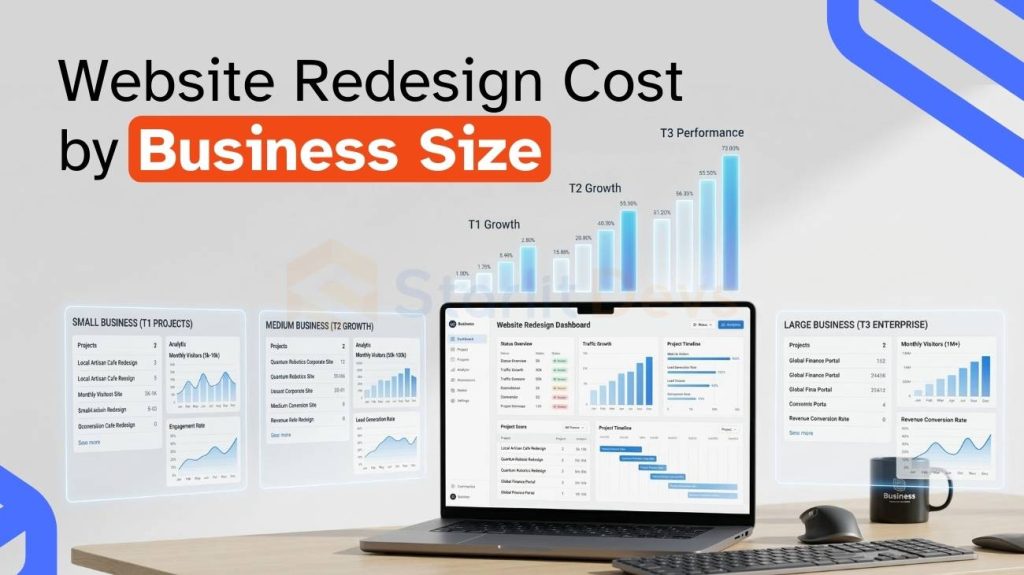
If you are wondering how much does a website redesign cost, the answer changes significantly based on company size and operational complexity.
A local service business and a national ecommerce brand will not have the same investment level.
Here is what most businesses realistically spend in 2026.
Small Business (5–20 Pages)
Typical Cost: $5,000 – $20,000
This usually includes:
- Template-based or semi-custom design
- Basic SEO setup
- Mobile optimization
- Contact forms and lead capture
- Limited integrations
Best for:
- Local service providers
- Consultants
- Early-stage startups
The goal here is credibility and lead generation. Not complex automation.
Growing Business or Ecommerce Brand
Typical Cost: $20,000 – $60,000
This range often includes:
- Custom UI design
- Conversion-focused UX
- Ecommerce functionality
- SEO migration
- Advanced forms or integrations
- Product filtering and checkout optimization
Ecommerce businesses typically require more testing and integration work. That drives cost higher.
If revenue depends heavily on online sales, investing in optimization becomes essential.
Mid-Market Company
Typical Cost: $50,000 – $120,000
Mid-sized companies often require:
- Deep UX research
- Brand refinement
- Complex CMS structure
- CRM or marketing automation integration
- Multi-location pages
- Advanced analytics setup
These projects are strategic, not cosmetic.
The redesign often aligns with business repositioning or expansion.
Enterprise or Multi-Location Brand
Typical Cost: $100,000 – $250,000+
Enterprise redesigns can include:
- Multi-site architecture
- Headless CMS implementation
- Custom applications
- Role-based dashboards
- Advanced security requirements
- Accessibility compliance at scale
- Extensive QA and stakeholder approvals
At this level, the website is a business infrastructure system.
Not just a marketing asset.
Why Business Size Matters
Larger organizations have:
- More stakeholders
- More integrations
- More compliance requirements
- More content to migrate
- Higher revenue risk during transition
That complexity directly increases redesign cost.
The better question is not only how much does a website redesign cost.
It is what level of business complexity your redesign must support.
DIY vs Freelancer vs Agency - Cost Comparison
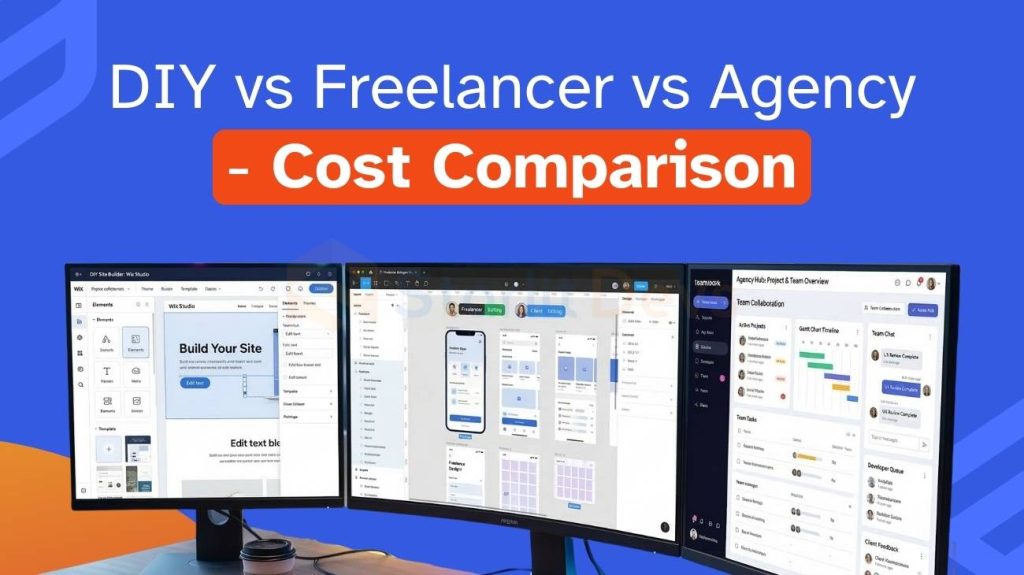
When evaluating how much does a website redesign cost, the provider you choose dramatically impacts both price and outcome.
The three most common paths are DIY, freelancer, or agency. Each comes with trade-offs.
Quick Comparison Overview
| Option | Cost Range | Quality Level | Risk Level | Best For |
|---|---|---|---|---|
DIY (Website Builder) |
$500 – $5,000 |
Basic |
High |
Solopreneurs |
Freelancer |
$3,000 – $15,000 |
Moderate |
Medium |
Small businesses |
Agency |
$15,000 – $150,000+ |
High |
Low |
Growth-focused companies |
Now let’s break them down.
DIY Website Redesign
Cost: $500 – $5,000
This usually includes:
- Premium template
- Website builder subscription
- Plugins or apps
- Basic hosting
Pros:
- Lowest upfront cost
- Full control
- Fast launch
Cons:
- Limited customization
- Weak strategic planning
- Higher long-term performance risk
- No structured SEO migration
DIY works if your website is simple and revenue does not heavily depend on conversion optimization.
But mistakes during redesign can cause ranking drops or broken functionality.
Freelancer Website Redesign
Cost: $3,000 – $15,000
Freelancers often offer:
- Custom design
- Development
- Basic SEO setup
- Limited integrations
Pros:
- More affordable than agencies
- Flexible
- Direct communication
Cons:
- Limited scalability
- One-person bandwidth
- Less structured testing process
- Higher risk for complex projects
Freelancers are ideal for small businesses needing moderate upgrades.
However, if your redesign involves ecommerce, automation, or complex integrations, risk increases.
Agency Website Redesign
Cost: $15,000 – $150,000+
Agencies typically provide:
- UX research
- Conversion rate optimization
- SEO migration strategy
- Custom UI design
- Development and QA teams
- Performance testing
- Post-launch support
Pros:
- Strategic approach
- Lower risk
- Team-based execution
- Scalability
Cons:
- Higher upfront investment
- Longer timelines
Agencies are best suited for businesses where the website directly impacts revenue and growth.
Which Option Is Right for You?
If your website is a digital brochure, DIY may work.
If your website generates consistent leads, a freelancer might be enough.
If your website drives significant revenue, handles ecommerce, or integrates with business systems, an agency-level redesign becomes a strategic investment.
The true answer to how much does a website redesign cost depends less on price and more on business impact.
Is a Website Redesign Worth the Cost?
If you are asking how much does a website redesign cost, you should also ask whether the investment generates measurable return.
For many businesses, the answer depends on performance impact.
1. Conversion Rate Improvement
A well-executed redesign improves:
- User experience
- Page speed
- Mobile usability
- Call-to-action clarity
Even a modest conversion increase can significantly impact revenue.
Example:
If your site generates 1,000 leads per month at a 2 percent conversion rate, improving to 3 percent increases conversions by 50 percent.
That alone can justify redesign costs.
2. Brand Perception and Trust
Outdated design reduces credibility.
Modern design improves:
- Authority
- Trust signals
- Visual consistency
- Professional image
For competitive industries, perception directly influences buyer decisions.
3. Technical Performance Gains
Redesign often improves:
- Core Web Vitals
- Load speed
- Mobile responsiveness
- Security
Faster sites reduce bounce rates and support SEO performance.
4. Revenue Growth Potential
If your website drives sales or lead generation, redesign is not a cosmetic upgrade.
It becomes a growth asset.
Simple ROI formula:
Additional monthly revenue × 12 months ÷ redesign cost = return multiple
If redesign generates $10,000 additional monthly revenue and costs $40,000, the annual return is $120,000.
That is a 3x return in the first year.
When It May Not Be Worth It
A redesign may not be necessary if:
- Your website already converts well
- Traffic is minimal
- The issue is marketing, not design
In those cases, optimization may be better than full redesign.
The true answer to how much does a website redesign cost should be framed against potential revenue growth.
Cost alone is incomplete without ROI context.
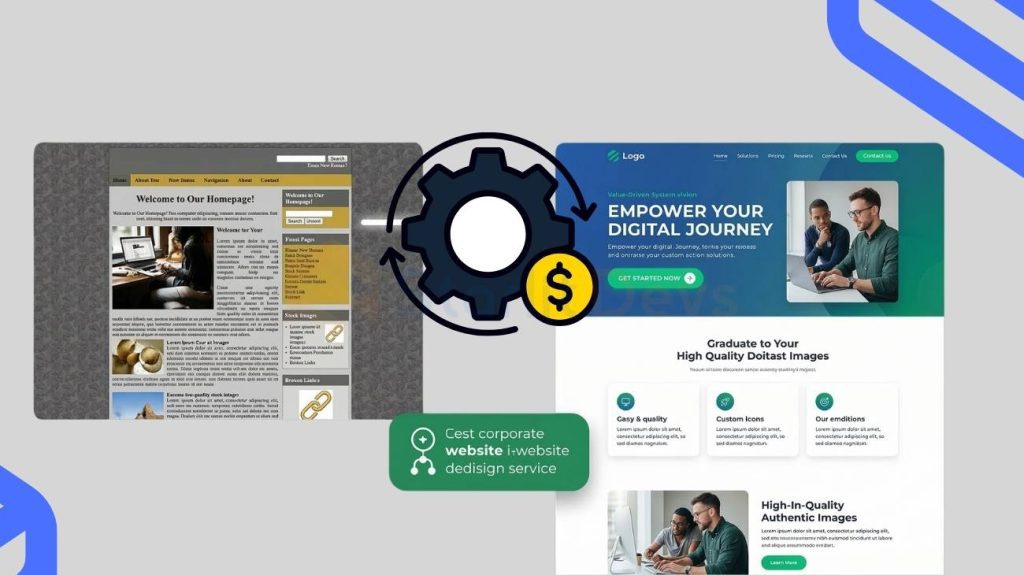
Hidden Costs of Website Redesign Most Businesses Miss
When estimating how much does a website redesign cost, many businesses focus only on design and development fees. That leaves out critical hidden expenses.
Key hidden costs include:
- SEO migration risks that can cause ranking and revenue loss
- Content rewrites for outdated pages and weak messaging
- Premium images, video, and licensing fees
- Hosting upgrades and security improvements
- CRM tools, plugins, and software subscriptions
- Internal team time and training costs
- Post-launch optimization and performance monitoring
Ignoring these factors often leads to budget overruns. Accounting for them provides a more realistic total investment estimate.
How to Budget for a Website Redesign (Step-by-Step)
If you are planning and wondering how much does a website redesign cost, budgeting properly prevents overspending and under-scoping.
Follow this structured approach.
Step 1: Define Clear Business Goals
Start with outcomes, not design preferences.
Are you trying to:
- Increase conversions?
- Improve SEO rankings?
- Reposition your brand?
- Support ecommerce growth?
Clear goals determine scope and budget.
Step 2: Audit Your Current Website
Review:
- Traffic performance
- Conversion rates
- Bounce rates
- Technical issues
- SEO rankings
This helps identify what must be rebuilt versus optimized.
Step 3: Define Scope Before Requesting Quotes
List required features:
- Page count
- Ecommerce functionality
- Integrations
- Content rewrite needs
- SEO migration
The clearer the scope, the more accurate the pricing.
Step 4: Choose the Right Provider Level
Match complexity to provider type:
- Simple site → Freelancer
- Growth-focused brand → Agency
- Enterprise system → Specialized team
Do not overpay for unnecessary complexity.
Do not underinvest in revenue-critical systems.
Step 5: Add a Contingency Buffer
Allocate 15 to 20 percent extra.
Unexpected needs often appear during redesign:
- Additional integrations
- Extra design revisions
- Content expansion
A buffer prevents budget stress.
Step 6: Plan for Ongoing Costs
Include:
- Hosting
- Maintenance
- Software subscriptions
- Post-launch optimization
Redesign is not a one-time event. It is part of your digital growth strategy.
Budgeting properly ensures you understand not just how much a website redesign costs upfront, but what it costs long term.
Final Verdict
So, how much does a website redesign cost? Most businesses invest between $15,000 and $60,000, while complex projects can exceed six figures. The real cost depends on strategy, functionality, and growth goals, not just design changes. A well-executed redesign improves conversions, protects SEO, and strengthens brand authority. If your website drives revenue, it should be treated as a growth asset.
At StarlitDevs, we approach redesigns strategically, combining UX, SEO, and performance optimization to ensure your investment delivers measurable results, not just a visual upgrade.
FAQs — Website Redesign Cost
Why is website redesign so expensive?
Because it includes strategy, design, development, testing, and often SEO migration. It is more than visual updates.
Can I redesign my website for free?
Yes, using free builders. But customization, performance, and scalability are limited.
How long does a redesign take?
Small sites: 4–8 weeks.
Mid-size: 8–16 weeks.
Enterprise: several months.
How often should a website be redesigned?
Typically every 2–4 years, or when performance drops.
Does redesigning hurt SEO?
It can. Proper redirect and SEO planning prevents ranking loss.
What is the average professional redesign cost?
Most businesses spend between $15,000 and $60,000.

Founding Starlit Devs has allowed us to extend our expertise globally, serving over 500 clients, including Fortune 1000 companies, with custom web development services. Our commitment to delivering exceptional design and development is coupled with a deep understanding of SEO, which has been pivotal in empowering businesses to achieve maximum online engagement and brand growth. At Starlit Devs, we take pride in our mission to provide websites that stand out in a competitive digital landscape and drive tangible results for our clients.
